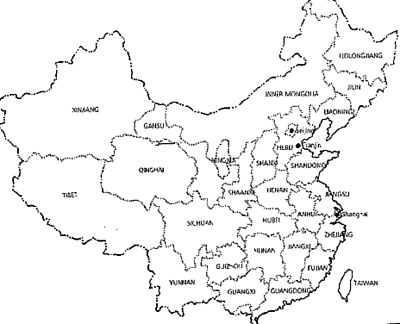
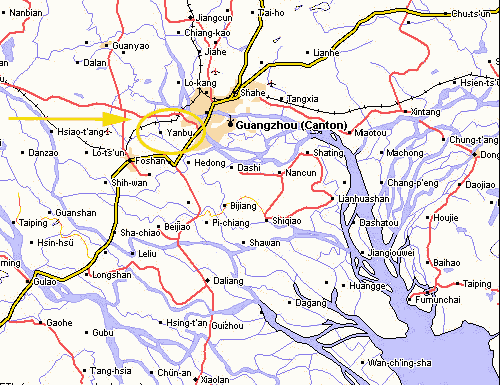
Our family originated from the Yanbu Village of the Nan Hai District which is in Guangdong Province of the People’s Republic of China. We now have relatives spread right across the globe, UK, Australia, New Zealand, Singapore, Brunei, Hong Kong and Malaysia.
……………………..
We have traced our ancestry back 5-6 generations to a common ancestor who made his way to Penang, Straits Settlement in the 19th Century.
The Liang Family and Clan History The Liang family name has been in existence for approximately 2600 years. The first Liang was Liang Kang Hou who was the ruler of the State of Liang, a small city-state based in the city of Shaoliang 少梁 (also known as Xiayang 夏阳) in eastern Shaanxi, on the border between Qin and Jin in the northwestern part of China. The State of Liang existed during the Zhao Dynasty of 1027 – 221 B.C. The descendents of Liang Kang Hou retained the name Liang as their surname in memory of the Liang state when it was annexed by the neighboring State of Qin in 641 B.C.
The Shiji mentions another small kingdom of Liang near the Zhou royal capital ca. 273 B.C. which was a different Liang kingdom from the one annexed in 641 B.C. (See “Shi Ji” extracts of, for the origins of the surname.)
The name Liang however, predates its first use as a family surname. The Liang family name is considered a dynastic name as there were two Dynasties and numerous states under the Liang name. The name Liang appears earliest as one of the Nine Ancient Provinces (Jiu Zhou) of China from the Tribute of Yu (Yu Gong) chapter of the Classic of Documents (Shangshu/Shujing). These were the domains of the legendary King Yu that were inherited by the Xia dynasty ca. 2200 B.C. 1) Jizhou 冀州 2) Yuzhou 豫州 3) Xuzhou 徐州 4) Yangzhou 扬州 5) Jingzhou 荆州 6) Qingzhou 青州 7) Yongzhou 雍州 8) Yanzhou 兖州 9) Liangzhou 梁州
The Han dynasty also used the same names as administrative regions expanding them to 12 such regions including Liangzhou.1) Jizhou 冀州: Central Hebei and/or Shanxi 2) Yuzhou 豫州: Henan 3) Xuzhou 徐州: Huai and Si River basins 4) Yangzhou 扬州: Lower Changjiang basin 5) Jingzhou 荆州: Middle Changjiang basin 6) Qingzhou 青州: Shandong Peninsula 7) Yongzhou 雍州: Wei River basin (Guanzhong) 8) Yanzhou 兖州: Southern Hebei 9) Liangzhou 梁州: Upper Han River basin 10) Youzhou 幽州: Northern Hebei into Inner Mongolia 11) Yingzhou 营州: Liaodong Peninsula 12) Bingzhou 并州: Shanxi and/or the Ordos Loop
The ancient name for the city of Kaifeng was Da Liang (大梁) or “Great Liang”
During the Eastern Han period, a time when the Han Dynasty was in chaos and decline, a power struggle ensured between three rival groups, the powerful eunuchs, the cliques of officials and the consort families of which the Liang was one of them. This was largely due to the fact that starting in A.D. 88, minors were placed on the throne and hence effective control of the Dynasty was in the hands of Regents. There were three successive empresses starting with Liang Na (梁妠) (A.D. 116-150), formally Empress Shunlie (順烈皇后, literally “the kind and achieving empress”), Liang Nuying (梁女瑩) (A.D. ???-159) formally Empress Yixian (懿獻皇后, literally “the meek and wise empress”) and the adopted Liang Mengnu (梁猛女) (A.D. ???-165) (Deng Mengnu or Bo Mengnu).
“The Liang family, by providing three empresses, became the effective ruler of the country by the middle of the second century, and its members accumulated a vast number of key posts. However, its rivals, the eunuchs, were able, due to their influence on the new emperor, to bring about its downfall, and the whole Liang clan was exterminated in 159AD.” – The Walled Kingdom (1984) Witold Rodzinski
In A.D. 159 a eunuch gang in the service of Huan-ti slaughtered relatives of the Empress Dowager Liang, effectively bringing an end to the Imperial aspirations of the Liang family.
Liang Dynastic Name The first major Liang Dynasty of A.D. 502 – 556 with its capital at Nanjing, was under the Emperor Wu Di. The dynasty was part of a period after the break-up of the Jin Dynasty, A.D. 265 – 420 called the Southern and Northern Dynasties, A.D. 520 – 588. The Liang Dynasty was one of the Southern Dynasties, the Song, Qi, Liang and the Chen, which struggled against the Northern non-Chinese Dynasties of the Later Wei, Eastern Wei, Western Wei, Northern Qi and Northern Zhou. Emperor Wu Di, or Hsiao Yen was a cousin of the Emperor of the Southern Qi. He held a fief in the strategic area of the Hsiang-yang, in the north of Hupei. In A.D. 502 he marched on Nanjing and eventually forced the cession of power to himself.
The Liang Dynasty under the Emperor Wu Di was a period of great cultural advancement. Buddhism thrived, as did literature, art and philosophy. The flourish of Buddhism in China during this period was very rapid under Emperor Wu Di. Shortly after his conversion from Confucianism to Buddhism in about A.D. 511, an envoy by the name of Song Yuan was sent to India to obtain new Buddhist text for study. He also invited 3000 monks to Nanjing from India from the Gupta Kingdom. One such monk, Paramartha who arrived in A.D. 548 set about translating many Indian Buddhist text. Another referenced monk from India is Monk Damo who came to Guangdong in A.D. 527
Prince Xiao Ming of the Liang Dynasty is considered an early Chinese thinker on Buddhism. His essays “On the Two Truths”, collected in the Kuang-hung-ming-chi (Taisho Tripitaka, vol. 52) and his “Two-bodies” theory represents one Chinese attempt to come to terms with Buddhism’s Maadhyamika philosophy of Naagaarjuna.
It was also during this period when Emperor’s eldest son, Liang Xiao Tong compiled China’s most famous anthology, the Wen Xuan (Literary Selections).
The second Liang Dynasty was called the Later Liang Dynasty, A.D. 907 – 923 with its capital at Kaifeng. The break-up of the Tang Dynasty, A.D. 618 – 907, resulted in the creation of 5 smaller Dynasties contending for the Mandate of Heaven. This period is known as the Five Dynasties and Ten Kingdoms, A.D. 907 – 960. The Later Liang was under the rule of Emperor Tai Zu.
The Five Dynasties included the Later Liang, Later Tang, Later Jin, Later Han and Later Zhou. Most historians tend to view the period as a great divide in Chinese history. The era’s military and political upheavals were just symptoms of deeper changes in the society.
This seemingly chaotic period was in fact less chaotic than other rebellious times, except from the point of view of the aristocrats, whose status disappeared along with their large estates, usually taken over in bits by their former managers. The aristocratic dominance in Chinese history was at an end, with a new bureaucratic era about to begin with the rise of the Song Dynasty, A.D. 960 – 1279.
The Famous Ancient Liangs There have been many significant Liangs in ancient Chinese history. Liang Hongyu was a female general and the wife of a mighty Song Dynasty general, Han Shizhong. Her tale is one of courage and strength. (See Liang Hongyu.)
Green Pearl is another Lady mentioned in ancient Chinese History. She was a singer and dancer who lived about the year A.D. 300. (See Green Pearl.)
Throughout Chinese history, scholars have been part and parcel of everyday life. The passing of government exams can mean high ranking posts of power and respect. There have been many famous chinese scholars through the 3000 years of Chinese history. The story of Liang Qichao (A.D. 1873 – 1929) is one such story.
In the 16th century, a scholar by the name of Liang Juyuan (A.D. 1527 – 1579), better known for his pseudonym Ho Xinyin, advocated and attempted to implement the conception of the ideal state, known as Clan Communism. In an essay, “Concerning the Theory: Fatherlessness and the Absence of Princes Are Not Identical with Parricide and Regicide” (Pien wu-fu wu-chun fei shih-fu shih-chun), he illustrated that Man has a consciousness of hierarchy and moral obligation. In A.D. 1553, he built the “Hall for Gathering in Harmony” (Chu-ho tang) in the Yang-feng district (Jiangxi province). He proposed that the powerful and far-flung Liang clan set up a kind of family commune with two principal areas of activity, a communal educational system, and the common cultivation of the fields.
Liang Fa, also known as ‘Ah Fa’, was the first Chinese Pastor in a Protestant church. Born in Gao He of Guangdong in A.D. 1784, Liang traveled to Guangzhou to study the technology of block printing in A.D. 1804. He met Robert Morrison (A.D. 1782 – 1834) in A.D. 1810 and began to print Bibles for Mr. Morrison, despite the ban by the Qing government. In A.D. 1815, Liang joined the British Missionary and was baptized the following year. Morrison made Liang the first Chinese pastor in Macao in A.D. 1824 and Liang later returned to preach in Guangzhou. Liang was also know for his work in editing and distributing Christian booklets (e.g., the Bible Homework, etc.) and flyers, and he turned his house into a meeting place for Christians. Liang died in Guangzhou in A.D. 1854. Liang’s work had quite a bit of impact on Hong Xiu Quan who initiated the Taiping Rebellion (A.D. 1851).
Another well know scholar is Liang Hong who in his own right has a claim to fame, but together with his wife, Meng Guang comes a story of love and respect. The Chinese phrase “holding the tray level with the eyebrows” pays tribute to the couple, and is used to this day, to characterize married couples who treat each other with love and respect.
However, not every love story turns out for the better as was in the case of Liang Shanbo (梁山伯) and Zhu Yingtai (祝英台). A well known legend and tale of tragic love. This tale is a well told tale immortalized in song and dance, tribute to the “Romeo and Juliet of the Ancient Chinese.
During the Song Dynasty in the 13th century A.D., there lived a well known Chinese painter called Liang Kai (A.D. 1140?-1210?). His works hail as some of the greatest works of Chinese classical art. Liang Kai pioneered an expressive and simplified style of ink painting. After becoming a Zen monk, he turned from his earlier landscapes to concentrate mainly on figure paintings done in a new technique using a wide, soft brush with a few deft and seemingly spontaneous strokes. Among some of his best works is a portrait of the Poet Li Bai (Li Po or Li Pai or Li Tai-Po) currently housed at the National Museum, Tokyo. For his contributions to humanity, Liang Kai has been immortalised by having a crater on Mercury named after him!
In the 8th century A.D., military engineer Liang Lingzan together with learned Buddhist monk Yixing, in trying to devise a more precise calendar, constructed a great astronomical clock on the grounds of the palace in Ch’ang-an. This ancestor of all modern clocks, completed in A.D. 721, was the first machine known to employ an escapement, the basic device that is still used to regulated clocks. It divided the power from a water-wheel into exactly similar unit impulses so that the apparent motions of stars and the less regular wanderings of the planets could be duplicated by the measurable movements of a bronze microcosm of rings and little spheres, while wooden figures struck out the sequence of the hours.
Other historical Liangs of significance that we are still trying to research are: Liang Yi & Liang Hong (Officials) – Spring-Autumn period in the Jin Kingdom. Liang Gonghong (Doctor) – Spring-Autumn period in the Chu Kingdom. Liang Shi – Mother of Wen-shi who in 290 B.C. was deified as Long Mu (Dragon’s Mother) Prince Liang Xiao Wang was in charge of arsenals containing several hundred thousand crossbows in 157 B.C. Liang Shang (梁商) (???- A.D. 141), Marquess of Chengshi and the grandson of a brother of Consort Liang, the mother of Emperor He. He was a Regent and Grand Marshal under emperor Shun, and was the father of the consort Liang Na (later Empress Liang Na to Emperor Shun) during the Han dynasty. Liang Ji (梁冀) (??? – A.D. 159) (Regent) courtesy name Bozhuo was the son of Liang Shang and Han Dynasty Grand Marshal under 4 Han emperors, emperor Shun, Chong, Zhi & Huan. He was a tyrant who’s excesses led the to tragic downfall of the entire Liang Clan at the hands of the Han Court Eunuchs Liang Buyi (梁不疑), son of Liang Shang and brother of Liang Ji was mayor of Luoyang in the Han dynasty. Liang Xing (???- A.D.219) was a rebel leader in the Chang’an area who was defeated and killed by Xiahou Yuan during the Three Kingdoms era. Liang Xu was the minister of Tian Shui of Wei during the Three Kingdoms era. Liang Xu later surrendered to the Shu army and was reappointed Prefect of Tian Shui. Liang Gang an officer who served under Yuan Shu of the Three Kingdoms era. He suffered a great loss when Yuan Shu attacked Lu Bu and was eventually captured and executed when defending Shouchun against Cao Cao. Empress Liang (梁皇后) (A.D. ??? – ca. 311) (Empress) was an Empress during Jin Dynasty (A.D. 265- 420) to the ill-fated Emperor Huai who was captured by Han Zhao forces in A.D. 311 Empress Liang (梁皇后) (A.D. ??? – 355) (Empress) was an Empress of the Former Qin who was executed together with her father Liang An (梁安), her uncle Mao Gui (毛貴) and her cousin Liang Leng (梁楞) by the Emperor in order to appease bad omens prophesized by court astrologers. Liang Cheng (General) of the Former Qin (ca. A.D. 357) who was defeated by an Eastern Jin General prior to the famous battle of Feishui. Empress Liang (梁皇后) (A.D. ??? – ca. 427) (Empress) was an Empress of the state of Xia. Her husband was the founding Emperor, Helian Bobo (Emperor Wulie). Liang Xiao (Empress) from a leading southern Liang family, Empress to Emperor Yangdi (A.D. 581- 604) of the Sui Dynasty. Xiao Xian from the Liang Imperial family declared himself “Emperor of Liang” in Southern China from A.D. 617-621. Liang Shi Du(King) – a person from Xiazhou of Sui Dynasty who started an uprising against Sui and self-proclaimed as emperor. His national symbol was Liang and his year symbol was Yonglong. He was the ruler of a Turk Vassal state north of Chang-an on the border of the Ordos Desert in Northern Shensi from A.D. 617-628. He was the last rebel from the Sui Period to be destroyed by the Tang in A.D. 628. Liang Chung-i was a Rebel Governor in Hsiang Yang Province during the Ho Pei Rebellions from A.D. 781 – 786. Liang Shou-chien was an Eunuch who was the first Commissioner of Privy Affairs (Shu-mi Shih) in A.D. 810 Liang I-Mai (Empress) to Liang Chi-Pu (Prime Minister) – The Liang clan held control of a Tangut state of Hsia during the Northern Sung, through a succession of Liang Empresses and Prime Ministers. Liang Shi Cheng (Judge) – Song Dynasty Liang Qing (General) – Song Dynasty Liang Te-Kuei (A.D. 1259 – 1304) was a Chinese administrator in Temur’s Court Liang Dao Ming (梁道明) was a 14th century Chinese king of Palembang, inhabiting Palembang, Srivijaya. According to Ming record, he had thousands of followers and a sizable army in Palembang who returned to Ming China with Admiral Zhenghe and was pardoned for piracy by emperor Chengzu. Liang Menglung (A.D. 1527 – 1602) was the Governor of Shantung Province who, with Tu Zemin the Governor of Fukien Province, pettitioned and got the Ming Government to lift the ban on Maritime activity, resulting in the great age of travel cummulating in the journeys of Admiral Cheng Ho. Liang Youyu (梁有譽) (A.D. 1521 – 1556) (Poet) was a native of Shunde in Guangdong province. He completed the Jinshi level of the Imperial Examination in A.D. 1550 and is known for his most famous work, Lanting Cungao (兰汀存稿) (Bibuji 比部集). He was a member of two well known poetry circles, “The Latter Five Poets of the Southern Garden” (南园后五子), and “The Seven Masters” (后七子). Liang Chenyu (A.D. 1520 – 1593) Chinese playwright and author of the first play of the K’un school (k’un-ch’�) of dramatic singing. He was born in K’un-shan in Kiangsu Province. When his great actor-friend Wei Liang-fu developed a new, more subtle and quiet style of dramatic singing, he asked Liang Ch’en-yu to create a showcase for his new style, and Liang complied by writing the “Huan sha chi” Liang Desheng (A.D. 1771 -1847) (Writer) – She completed the Tanci Zai sheng yuan (The destiny of rebirth), left unfinished by Chen Duangshen. Liang Tingnan of the Qing Dynasty compiled the Tenghuating or Mirror Catalogue. Liang Guo Zhi (General) – Qing Dynasty Liang Zhang Ju was a prolific writer who passed the Imperial Examination during the reign of Emperor Jia Qing (A.D. 1796 – 1820) and became a Jin Shi. He was appointed an official and eventually became the Governor of the provinces of Jiangsu and Jiangxi. Liang Si Cheng (Engineer, Architect) – son of Liang Qichao and a person of Guangdong Xinhui who participated in countless designing of important structures in China, Beijing. Liang Kuan (Martial Artist) – a disciple of the famous Huang Fei-hong. Liang Kun (ca. 1815 – ca. 1887) (Martial Artist) – better known as Tieqiaosan or Iron Fist Three, Liang Kun was one of the “Ten Tigers of Guangdong”, the best in Southern China. He was also known as the Great Master of the Hong Fist. Liang Shiyi (Politician) – appointed Prime Minister in A.D. 1921 for the government of Beiyang. Wing Chun Grandmasters Leung Jan (Liang Zan), or Leung Dak Wing (Liang Derong) (ca. 1816�1826 – ???), like his father, was a herbal Doctor and ran a pharmacy on Fai Jee Street. Leung Yee Tai (Liang Erdi) was the Professional/Stage name of a member of the King Fa Wui Goon Opera, in the 1850’s who taught Leung Jan Wing Chun. In most oral traditions, he was a full member of the Opera troupe who played the role of Mo-Deng (“female” martial lead). Leung Lan Kwai (Liang Langui) was said in some stories, to have been a wealthy scholar from Guangzhou, and in other�s, an osteopath from the Foshan or Zhaoqing region who learnt Wing Chun from Leung Bok Lao. Leung Bok Lao (ca. 1771 � 1859?) (Liang Bochou, Leung Bok Chao or Liang Boliu) was the husband of Yim Wing Chun and is credited with naming and teaching the Wing Chun System. Then of course there is the folktale about Liang and the Magic Paintbrush – can anyone confirm whether this is a a true folktale?
The Liang Star The Liang Family has a star bearing the surname. In the Chinese star-chart, within the Eastern (Azure Dragon) quardrant of the sky, on the “Youyuan (Right Wall)” constellation of the “Heavenly Market Enclosure” group is a star called Liang. This star in the western star-chart corresponds to the star “Yed Prior” of the “Ophiuchus (Serpent- bearer)” constellation. It’s coordinates are R.A. 16h15m Dec. -3.7 degrees, has a brightness of Magnitude 2.76 and is 172 Lightyears from Earth.
I am still researching the History of the Family. Please do help me by feeding me with information if you have any that might be useful.
Written by Leong Kit Meng Leong Family Tree Copyright 2007 All Rights Reserved
The family name “Liang” is the 21st most common Chinese surname and has taken many forms since its inception 2600 years ago. (See Shi Ji extracts of). The many dialects of the Chinese Provinces have resulted in a myriad of pronunciations, some of which have become completely dissimilar with the others. This was further complicated with the representation of the name using the English Alphabet. The various forms would have resulted in a total dichotomy of the surnames if not for the unity of the Chinese written language. The character for the surname, remains the same whichever way it is pronounced.
The official Hanyu-pinyin form is “Liang2”. The 2 represents the second sound of the four sounds associated with each Chinese Character. This is the official form and pronunciation for the surname in China. In most of the various dialects of China, the surname is still generally pronounced as “lian|”. The Beijing, Jinan, Xian, Suzhou and Chaozhou all use this form. Other dialects such as the Hankou, Chendu and Shuangfeng pronounce a variant, “nian|”. Others include “lia_~” in Taiyuan. “li” in Wenzhou. “nian” in Changsha. “lio|n|” in Nanchang, Meixian and Xiamen. “luo|n|” in Fuzhou. (See Chinese Dialects.)
However, it is in the overseas Chinese population where many written dialect forms emerge. The settling of Chinese migrants, either through trade or through flight from turmoil, all over the world has resulted in pockets of similar dialect speaking Chinese communities. Most of these overseas communities originated from the southern Chinese provinces of Guangdong, Hainan, Guangxi and Fujian. The traditional dialects of the majority of the people in these provinces are Cantonese, Hokkien, Teochew, Hakka and Hainanese.
The Cantonese in Hong Kong take up the spelling of “Leung”, following the Cantonese pronunciation “lo”_n|” for the “Liang” Chinese character. This is also the prevailing spelling format for most overseas Chinese communities in the Chinatowns of the Western world. This is because the majority of these people originate from Hong Kong and the surrounding Pearl River Delta of Guangdong Province. However, with the Cantonese in Malaysia and Singapore, the “Liang” is spelt as “Leong”, with the “u” substituted with the “o”.
The Hokkien pronunciation is “Liang” or “Nion”, both in a lower level (Yang Ping) tone. This form can be found in the Hokkien communities of northern Malaysia and in Singapore. The Hokkiens traditionally are from the vicinity of Xiamen, Fuzhou and Quanzhou in Fujian Province, neighboring the Taiwan Straits.
The Teochew community in Malaysia and Singapore, pronounce and use the surname “Liang” or “Neoh”. The Teochews are from the region around the City of Shantou, in the prefecture of Chaozhou of Eastern Guangdong Province, neighboring Fujian Province.
The Hakka pronunciation for the surname is “Leong,” similar to that of the Cantonese, but pronounced with a slightly different accent.
The Hainanese pronounce the name as “Leo”. The Hainanese are from the island of Hainan in the southern most tip of China.
Recently, we’ve been contacted by someone from Peru with the surname “León”. The Liang surname is represented by the surname “León” there, a result of the translation into Spanish. The community is a small community, mostly originating from Guangdong Province.
The surname doesn’t only exist within the Chinese community and culture. The Japanese and the Koreans also carry the surname. This is not unusual since the Japanese Kanji and the old Korean text are Chinese in origin. The Liang family name is pronounced as “Ryou” in Japanese, while with the Koreans, the name is pronounced as “Lyang”.
The Vietnamese and Cambodians also share a similar linguistic background from the Chinese. The Northern part of Vietnam is known as Annam. The ancient Annamese share a similar written character set with that of the ancient Chinese. Vietnamese and Cambodian was only converted to the English alphabet during the French colonization of Indochina. Because of this, the Liangs have “cousins” in Vietnam and Cambodia under the name Luong and Loeung respectively, but both pronounced as “Lu’o\’ng”. (See Dylan’s Chinese Writing and its Influence.)
There is one reference which was found at the Yutopian Enterprises website which gives this comment to the Liang surname – “The Conquerors of the West”.We are not sure where this reference is from or what it means, but are currently trying to research it.
Many thanks to Sergei Starostin, Dylan W.H. Sung, Stanley Leng, Peter Loeung and Arturo León for their invaluable help in providing me additional information for my research.
The information contained within the various pages, is as accurate as is feasibly possible. There are various links containing information on various items.
This site contains the on-going project to map our complete family tree. Visitors are welcome to browse through the information available.
We are also researching the origin of the surname as well as the Liang Family History. Our information is gathered from many, many sources and we would like to thank all who have contributed and helped us in our research.
Please do contact us if you like our site or have any information to share with us. We would love to hear from you. Click here for a special flash presentation on the Liang Surname!! .
Please be patient as the file is quite large. The file as well as its links may take some time to load.
Started on the 4th of February 1998 Website Designed and Maintained by WebImage International Copyright 2019 WebImage International All Rights Reserved

 The Leong Family Tree